
Sustainable Valve Technology for Industrial Applications
Our Control Valves

Control Valves for Industrial Plants and Controlled Process Control
Control valves play a central role in industrial plants: They regulate flow, pressure, and the movement of fluids in applications where stable processes are critical. Even small fluctuations can have a significant impact on energy consumption, product quality, or operational safety in production facilities.
We develop control valves for applications in mechanical engineering, plant engineering, chemical engineering, refrigeration technology, and industrial process control. Our valves are used wherever media must be precisely controlled and where high loads occur during continuous operation.
Control Valves for High-Pressure and Process Industries – Typical Challenges
In modern industrial facilities, the demands placed on control technology are constantly increasing. Production lines are operating faster, equipment is becoming more compact, and at the same time, energy consumption and maintenance costs are expected to decrease.
Common challenges with control valves:
- fluctuating pressure conditions
- high operating pressures
- aggressive or temperature-sensitive media
- unstable flow rates
- rapid load cycles
- High wear when unsuitable materials are used
- Pressure surges in piping systems
- inaccurate control characteristics
- strict requirements for leak tightness
- limited installation space in machine modules
Particularly in chemical engineering, refrigeration technology, and the process industry, imprecise control processes often lead to increased energy consumption, unstable processes, or unnecessary plant downtime.
Many standard valves reach their limits when high-pressure ranges, aggressive media, or constantly changing load conditions are present.


Control valves in plant engineering offer economic advantages
Control valves directly affect the stability and efficiency of an entire system. A properly tuned control process reduces energy losses, prevents pressure fluctuations, and lowers maintenance costs.
Advantages of our control valves:
- Controlled flow regulation
- stable pressure conditions
- high pressure resistance
- long service life
- reduced energy losses
- short maintenance intervals
- compact designs
- Seamless integration with existing systems
- high temperature resistance
- flexible configuration options
- Reliable operation under varying load conditions
- Cost-Effective Plant Operation
In automated systems in particular, stable control characteristics ensure that processes remain consistently reproducible.
RSG Control Valves: A Solution for Industrial Process Control
Our control valves are specifically designed for industrial applications where stable control processes and controlled flow rates are critical. Depending on the application, we configure the valves in terms of material, control characteristics, pressure range, and actuation type.
Our control valves are suitable for, among other things:
- industrial refrigeration
- Chemical Plants
- Refrigeration Systems
- Mechanical Engineering
- Processing industry
- Gas Technology
- Compressed air systems
- Water Treatment
- Energy Facilities
- automated production systems
Technical Specifications of Our Control Valves:
- Pressure ranges up to 450 bar
- high temperature resistance
- Controlled flow regulation
- various Kv values
- stable control characteristics
- high resistance to media
- compact designs
- long service life
- low-maintenance designs
- Integration into Automation Systems
Available materials:
- Stainless steel 1.4305
- Stainless steel 1.4571
- brass
- Galvanized steel
- aluminum
Available models:
- pneumatic control valves
- electric control valves
- Directly Actuated Control Valves
- Servo-controlled control valves
- High-Pressure Control Valves

Control valves in plant engineering offer economic advantages
Control valves directly affect the stability and efficiency of an entire system. A properly tuned control process reduces energy losses, prevents pressure fluctuations, and lowers maintenance costs.
Advantages of our control valves:
- Controlled flow regulation
- stable pressure conditions
- high pressure resistance
- long service life
- reduced energy losses
- short maintenance intervals
- compact designs
- Seamless integration with existing systems
- high temperature resistance
- flexible configuration options
- Reliable operation under varying load conditions
- Cost-Effective Plant Operation
In automated systems in particular, stable control characteristics ensure that processes remain consistently reproducible.
Control Valves in Chemical Engineering, Refrigeration, and Mechanical Engineering – Project Examples
Our control valves are used worldwide in a wide variety of industrial sectors.
In a chemical engineering process plant, stainless steel control valves were used to maintain constant control of corrosive media under varying pressure conditions. This significantly reduced pressure fluctuations within the plant.
A manufacturer of industrial refrigeration systems uses our high-pressure control valves for CO2 refrigeration systems with frequent load changes. The optimized control characteristics have improved the stability of the entire system.
Our control valves are also used in mechanical engineering, for example in automated production lines with fast cycle times and varying flow rates.
Other applications for our control valves:
- chemical engineering
- Refrigeration Technology
- medical technology
- Processing industry
- Energy Technology
- Mechanical Engineering
- industrial refrigeration
- plant engineering
- Water Treatment
- Automation Technology
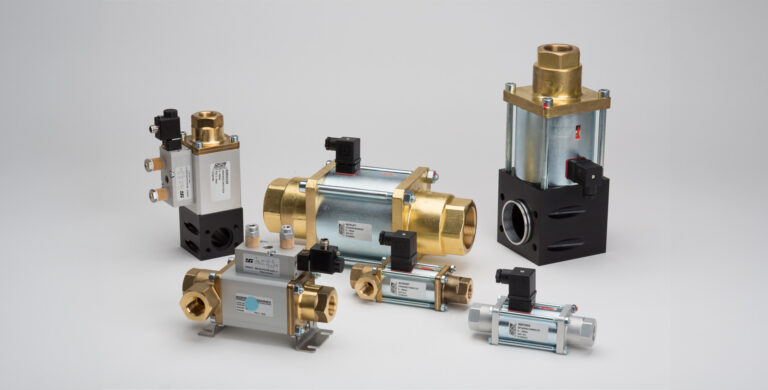

Stainless steel control valves for stable flow control
The choice of the appropriate material and the right control technology determines the service life and stability of a control valve.
Stainless steel 1.4571 is particularly well-suited for aggressive media and high-temperature applications. In chemical plants and industrial cooling systems, this material ensures a long service life and reduces corrosion problems.
Brass is often used when cost-effective solutions are needed for compressed air or water applications.
In addition to the material, the design of the Kv value also plays an important role. A control valve will only operate stably over the long term if the flow rate, pressure range, and control characteristics are properly matched.
That is why we assist our customers with the technical design of valves from the very beginning.
Control valve manufacturers from Germany offering technical consulting
For over 30 years, we have been developing and manufacturing valve technology for industrial applications at our facility in Germany. Our control valves are used worldwide in process plants, refrigeration systems, and industrial control systems.
Thanks to our modular system, we can cost-effectively produce both standard valves and custom solutions.
What sets us apart as a manufacturer of control valves:
- Manufactured in Germany
- ISO-certified processes
- Technical advice from experienced representatives
- Support for Valve Design
- high delivery capacity
- Solutions for Mass Production and Special Projects
- quick decision-making processes
- Personalized support for buyers and technicians
Our clients come from, among other places:
- chemical engineering
- Mechanical Engineering
- Processing industry
- Refrigeration Technology
- Energy Technology
- medical technology
- plant engineering
- Automation Technology

Control Valves for Industrial Process Control: An Overview
Control valves ensure controlled flow rates, stable pressure conditions, and consistent process operations in industrial plants. Stable control processes are particularly crucial in high-pressure applications, with aggressive media, or under varying load conditions.
Our control valves combine:
- high pressure resistance
- Controlled flow regulation
- stable control characteristics
- long service life
- compact designs
- high temperature resistance
- Cost-effective maintenance intervals
- flexible configuration options
- technical consulting
- Manufactured in Germany
Whether it's chemical engineering, industrial cooling, or automated production systems—we develop control valves tailored to your application.
Control Valves: Consulting and Technical Support
Choosing the right control valve affects the stability of the entire system. That is why we provide support right from the technical planning and design phase.
Use our contact form to get quick assistance from our technical team.
FAQ – Control Valves for Industrial Plants and Process Control
Control valves regulate flow rates, pressure conditions, and the movement of fluids within a system. In this way, they ensure stable processes and consistent operating conditions.
High-pressure control valves are used wherever high operating pressures occur, such as in CO2 refrigeration systems, chemical plants, or industrial process systems.
The Kv value describes the flow capacity of a control valve. Proper sizing affects the control behavior, pressure drop, and stability of the entire system.
Our control valves are suitable for liquids, industrial gases, compressed air, cooling media, and corrosive media. The exact design depends on the pressure range, temperature, and medium.
Pneumatic control valves use compressed air as their actuating force and are frequently used in industrial process plants. Electric control valves use electric actuators and are particularly well-suited for automated control systems.
Materials have a significant impact on corrosion resistance, temperature behavior, and service life. For example, 1.4571 stainless steel is particularly well-suited for aggressive media and high loads.
Control valves are used in fields such as chemical engineering, refrigeration engineering, mechanical engineering, energy engineering, water treatment, and industrial process control.
For the design, we consider the medium, pressure range, temperature, flow rate, and switching frequency. We then select the material, Kv value, and actuation type appropriate for the application.